Comparisons
Grok Bot vs Orbit: Which One Should Run Your AI Agents in 2026?
xAI's Grok Bot gives you an always-on AI teammate. Orbit gives every AI teammate you already have, Grok Bot included, one shared memory and one place to watch them work. Here's how they actually compare.
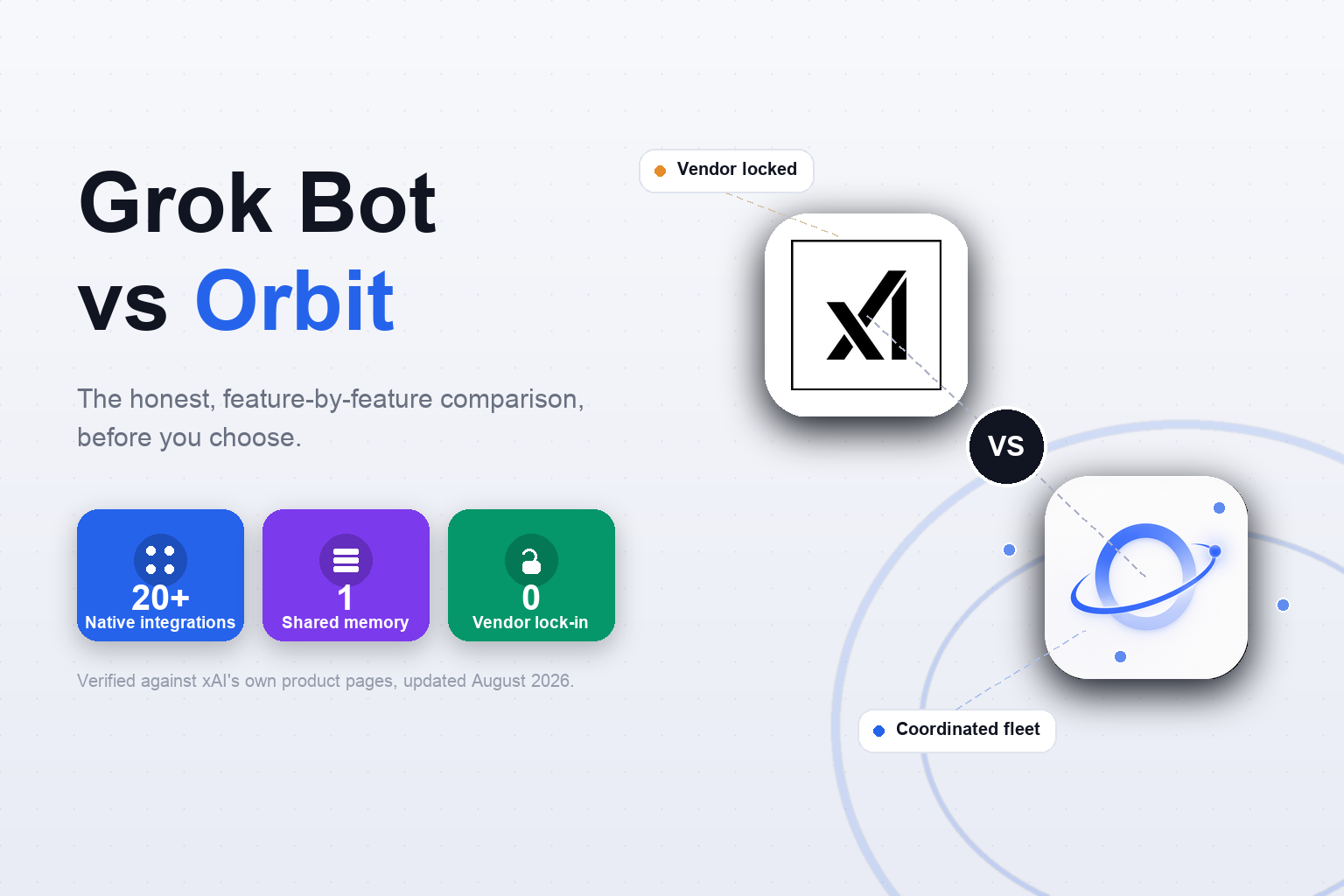
xAI shipped Grok Bot in beta on August 11, 2026, an always-on AI agent that gets its own cloud computer, signs into your existing tools, and keeps working after you close your laptop. Two weeks later, on August 26, xAI dropped the entry price roughly 10x by folding Grok Bot into every SuperGrok and Cursor plan, down to Cursor Pro at $20 a month. That's a fast, aggressive rollout, and it's the closest xAI has come to shipping a genuine "AI employee" product.
Naturally, people are asking how it stacks up against Orbit. It's a fair question, and also slightly the wrong one, because Grok Bot and Orbit aren't really competing for the same job. Here's the honest breakdown.
What Grok Bot actually is
Grok Bot is a single autonomous agent (or a small team of them) that runs on its own cloud computer, complete with a browser, file system, and terminal. You assign it a role, it signs into your existing accounts once, and it works end to end on tasks like research, coding (it shipped jointly with Cursor), inbox triage, or scheduled "routines," only coming back to you when it needs approval or hits a wall.
Worth separating the two pieces, since people often conflate them: Grok 4.6 is the underlying intelligence model developed by xAI, while Grok Bot is a persistent, task-oriented agent platform that runs on a cloud virtual machine using that model. The model is the brain, Grok Bot is the body it's given, its own machine, its own logins, its own ability to keep working after you've closed your laptop.
It's built by xAI, on top of Grok's models, and it lives inside the Grok and Cursor ecosystem. That's the whole point: one AI, one vendor, one place to assign it work, and it just goes and does it.
What Orbit actually is
Orbit is the operating system that sits above the agents you're already running, whether that's Claude, Codex, ChatGPT, Grok Bot, or all of them at once. Every agent reads the same active decisions before it acts, contradictions between agents get flagged before they ship, and you get one dashboard showing what every agent did, is doing, and still needs your sign-off on.
Orbit also isn't just the coordination layer. It ships its own agents too, ready-made ones you install from the Agent Marketplace in seconds, or custom ones you spin up in the Agent Builder when you need something scoped to one specific job. Those agents come with tools wired in already, no separate API keys, no separate setup.
Where Grok Bot answers "who does the work," Orbit answers "how do I actually see and control a fleet of agents that don't natively talk to each other." Build the AI empire that runs with you, the operating system for Claude, Codex, ChatGPT, and more.
Grok Bot vs Orbit: full comparison
| Grok Bot | Orbit | |
|---|---|---|
| What it is | A single autonomous AI agent (or small team) from xAI | A coordination and visibility layer across all your AI agents |
| Which models it runs on | xAI's Grok models only | Model-agnostic, works with Claude, Codex, ChatGPT, and more |
| Best for | Handing off one defined task to run unattended | Running a business on multiple agents at once |
| Shared memory across tools | No, memory is scoped to Grok Bot itself | Yes, one source of truth every connected agent reads |
| Cross-agent contradiction catching | Not applicable, single-vendor agent | Yes, flags conflicts before they ship |
| Native browser/terminal/file access | Yes, each bot gets its own cloud computer | Depends on the underlying agent (Claude/Codex/etc.), Orbit sits above it |
| Coding-specific tooling | Strong, shipped jointly with Cursor | Not a coding tool, coordinates whatever coding agent you already use |
| Multi-bot coordination | Yes, within the Grok Bot product itself | Yes, across every agent regardless of vendor |
| Visibility dashboard for a human operator | Limited to Grok Bot's own tasks | One dashboard for your entire AI workforce |
| Setup | Sign into SuperGrok or Cursor, assign a role | No-code, connect a URL or drop a file |
| Pre-built agents | No marketplace, you configure the bot yourself | Agent Marketplace, install a ready-made agent in seconds |
| Custom agent creation | Manual role assignment, no dedicated builder | Agent Builder, turn a goal into a working agent in minutes |
| Native tool integrations | Browser, terminal, file system (general-purpose) | 20+ pre-wired integrations across social/messaging, premium data (Apify, Apollo, PredictLeads, Perplexity), and business tools (HubSpot, Salesforce, Stripe, Instantly), new ones shipping weekly |
| Pricing | Included from Cursor Pro ($20/mo) up to SuperGrok Heavy ($300/mo) | See current Orbit plans |
| Vendor lock-in | Tied to the Grok/Cursor ecosystem | None, designed to sit across ecosystems |
Where Grok Bot wins
Credit where it's due. If you're already living inside Cursor for coding and SuperGrok for everything else, Grok Bot is a genuinely strong product:
- Native execution environment. Each bot gets a real cloud computer, its own browser, file system, and terminal, so it can actually do things, not just describe them.
- Deep coding integration. Shipping jointly with Cursor means Grok Bot's coding agent has tooling most general-purpose agents don't.
- Zero extra setup if you're already paying for it. As of August 26, Grok Bot rides along on plans you may already have, from Cursor Pro at $20/month up.
- Genuine persistence. It keeps working after you close your laptop, which is a real unlock if your workflow is "assign it Monday, check back Friday."
If your whole operation lives inside one AI vendor's ecosystem and you want an agent that just executes, Grok Bot is built exactly for that.
Where Orbit wins
Almost nobody actually runs one AI vendor. If you're a solo founder or a small team, your reality probably looks like Claude for one thing, Codex or Cursor for coding, ChatGPT for another, and now maybe Grok Bot for autonomous tasks. That's exactly the gap Orbit is built for:
- Cross-vendor by design. Orbit doesn't care which model is doing the work. It coordinates Claude, Codex, ChatGPT, Grok Bot, and whatever you add next, from one place.
- Shared memory that actually compounds. A decision made in one agent's session (a price, a policy, a positioning line) is visible to every other agent's next run, not siloed inside one vendor's product.
- Contradiction catching before it ships. If one agent is about to act on stale information another agent already corrected, Orbit flags it. No single-vendor agent product does this across vendors, because it isn't in their interest to.
- Built for the operator, not just the agent. You get one view of your entire AI workforce (what ran, what's pending your approval, what's still open) instead of checking each vendor's own dashboard separately.
- No lock-in. Add a new tool tomorrow and it plugs into the same shared memory. You're not betting your operations on one company's roadmap.
- Pre-built agents for the specific job you need done. Grok Bot gives you a blank agent and asks you to define its role from scratch. Orbit's Agent Marketplace is a library of agents ready when you are, install a ready-made agent in seconds instead of configuring one from zero.
- An actual Agent Builder for anything the marketplace doesn't cover. When you need something narrower than an off-the-shelf agent, the Agent Builder turns a goal into a working agent in minutes, so you can spin up an agent scoped tightly to one specific job (a niche outreach motion, a single content vertical, one recurring report) instead of one general-purpose bot doing everything loosely.
- Native tools already wired in, not a generic browser and terminal. Grok Bot gives every agent the same general-purpose cloud computer. Orbit's provisioned agents come with 20+ integrations pre-wired, social and messaging (LinkedIn, WhatsApp, Instagram, Telegram, X, Gmail), premium data sources (Apify, Apollo, PredictLeads, Perplexity), and business tools (HubSpot, Salesforce, Stripe, Instantly), no API keys, no setup, with new integrations shipping every week.
This is the core of what makes Orbit different from every "AI agent" product on the market, including Grok Bot: it isn't trying to be the agent doing your work. It's the command center for your Claude work, and every other AI agent, one shared memory and one place to see, manage, and run your operations.
The honest verdict: they're not really competitors
If you're choosing between "an autonomous agent that executes tasks" and "a layer that coordinates every agent you run," you're not actually choosing between two versions of the same tool. You're choosing whether you have one AI agent or several, and if you're running more than one (see our full playbook on managing multiple AI agents as a solo founder), the honest answer is you need both kinds of tool, not one instead of the other.
Grok Bot can be one of the agents in your fleet. Orbit is what keeps that fleet, Grok Bot included, from stepping on its own feet. Hire agents that come with tools wired in, no API keys, no setup, and get 10x the output without babysitting every one of them individually.
If you're running Grok Bot, Claude, Codex, or ChatGPT (or all four), take a look at orbitagents.xyz and see what one shared memory across all of them actually looks like.
Frequently asked questions
- Is Grok Bot a competitor to Orbit?
- Not directly. Grok Bot is a single-vendor autonomous agent built by xAI. Orbit is a coordination layer that works across agents from any vendor, including Grok Bot. Most founders running multiple AI tools will want a coordination layer regardless of which agents they use to actually do the work.
- Can I use Grok Bot and Orbit together?
- Yes. Orbit is model-agnostic and designed to sit above whatever agents you're already running. If Grok Bot is one of your AI teammates, Orbit gives you shared memory and visibility across Grok Bot and every other agent in your stack.
- How much does Grok Bot cost compared to Orbit?
- As of August 26, 2026, Grok Bot is included starting at Cursor Pro ($20/month) up through SuperGrok Heavy (roughly $300/month), depending on the plan. Orbit's current pricing is available at orbitagents.xyz.
- Does Orbit replace my coding agent or Grok Bot itself?
- No. Orbit doesn't do the underlying work your agents do, it coordinates them. You'd still use Grok Bot, Claude, Codex, or ChatGPT to actually execute tasks. Orbit makes sure they're all working from the same decisions and that nothing contradictory ships silently.
Build your autonomous AI company
Orbit gives your AI clients shared memory, provisioned tools and agents that run like trained employees.
Get started free