Comparisons
Obsidian Alternative for AI Agents: Notes for You, Memory for Agents
Obsidian is a brilliant second brain for a person. Here's where it breaks down when AI agents do the writing, and what to use for them instead.
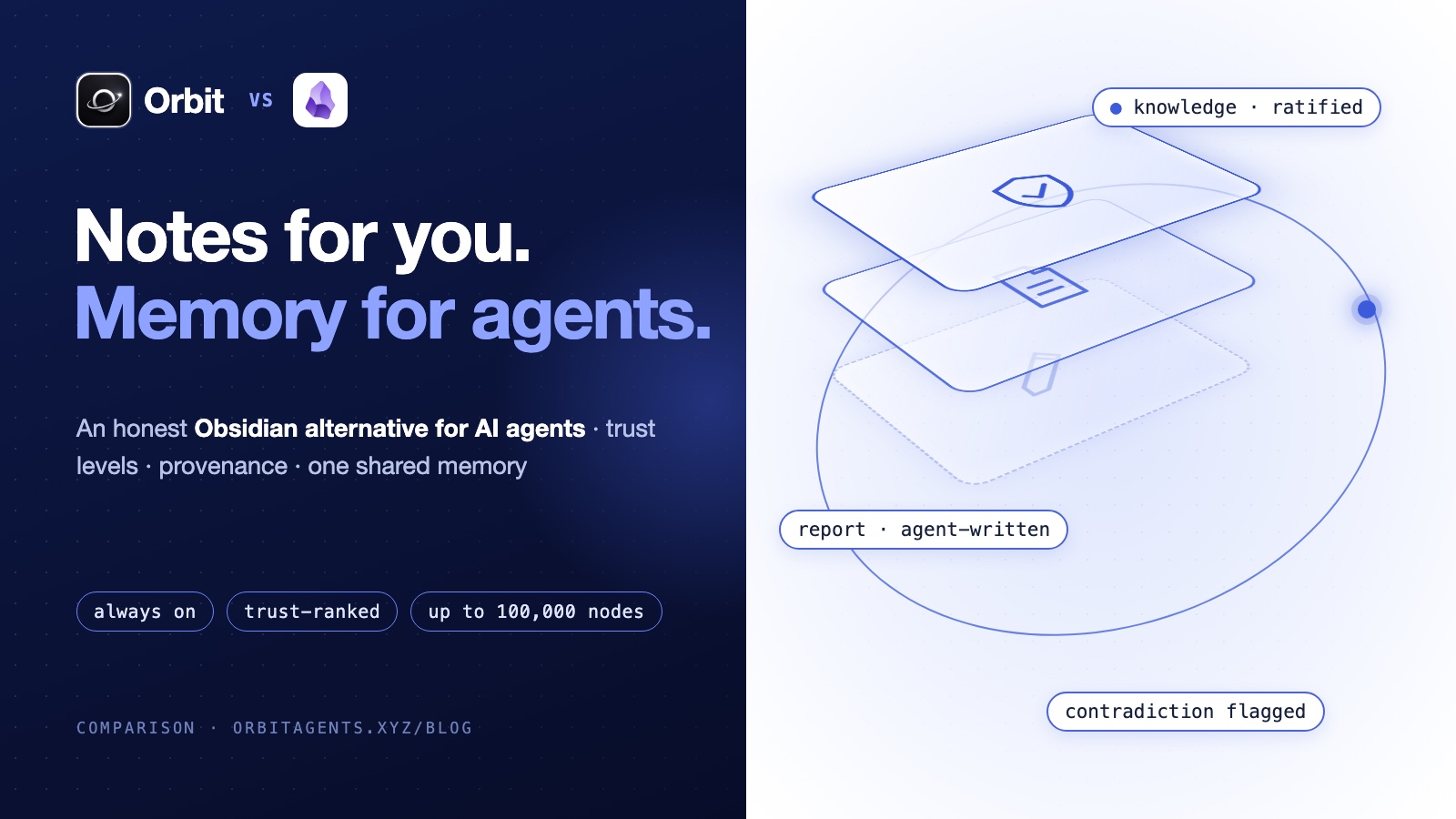
Obsidian is the best place I know to keep my own thinking. It is not where I'd keep my agents' memory.
That distinction matters more every month. A year ago the question was "can Claude read my Obsidian vault?" Now plenty of people have that working, through an MCP server or the new CLI, and they're running into the next problem: the vault was built for one human writing notes, and it's now being written to by three agents on a schedule. The notes pile up, two agents disagree, and nobody can tell which note is the one that's actually true.
If that's where you are, you don't need a better notes app. You need a memory layer built for agents. Here's an honest look at where Obsidian is still the right tool, where it breaks down for agents, and what to use instead.
What Obsidian gets right
Credit first, because Obsidian earns it.
- It's free and it's yours. Obsidian is free for personal use with no sign-up, and commercial use doesn't require a paid license either (the $50 per user per year commercial license is optional support).
- Your notes are plain files on your device. Open formats, no lock-in, works offline. If Obsidian disappeared tomorrow, your Markdown would still be there.
- It's endlessly shapeable. Thousands of community plugins and themes, a graph view for seeing how notes connect, and Canvas for laying out ideas.
- Agents can reach it now. Since Obsidian 1.12 there's an official CLI, generally available from February 27, 2026, that can do almost anything the app can do. The popular Local REST API plugin also ships a built-in MCP server, so Claude and other MCP clients can read, search and patch notes directly.
For a personal knowledge base, a writing workspace or a research journal, I wouldn't switch. Obsidian is excellent at the job it was designed for.
Where Obsidian breaks down when agents do the writing
The trouble starts when the main writers are no longer you. Four places it shows up.
1. It lives on one machine
Obsidian's own docs say the CLI requires the app to be running, and the Local REST API plugin's MCP server runs inside Obsidian at a local address on your computer. That's a fine design for a personal tool. It also means an agent running in the cloud at 3am can't reach a vault on a laptop that's closed. Your agents' memory is only as available as your MacBook.
2. Every note is equal
In a vault, a note an agent wrote in passing looks exactly like a decision you signed off on. There's no built-in idea of which note is ratified truth, which is a finished report and which is scratch. For a human that's fine, because you remember what you meant. An agent reading the vault next week has no way to know, so it treats a half-finished brainstorm with the same weight as your final pricing.
3. Nobody arbitrates contradictions
Agent one writes "we target solo founders." Agent two, a week later, writes "our ICP is 10 to 50 person teams." Both notes sit in the vault. Nothing flags that they conflict, and the third agent picks whichever one its search happens to return. I wrote about this failure mode in how to manage multiple AI agents as a solo founder: it's rarely the model that's wrong, it's that nothing holds one version of the truth.
4. Sharing is built for people, not agents
Obsidian Sync ($4 a month billed yearly, or $5 monthly) is a solid product with end-to-end encryption and version history. You can share a vault with up to 20 collaborators, but each one is a person invited by email with their own Sync subscription, edits appear only after syncing, and simultaneous edits are merged during sync. That's reasonable for a small team of humans. It isn't a model for five agents writing to the same memory several times an hour.
None of this is a flaw in Obsidian. It's a notes app, and these are memory-layer problems.
What agents actually need from memory
If you're choosing an Obsidian alternative for AI agents, this is the checklist I'd use:
- Always on. Reachable by any agent, from any client, whether your laptop is open or not.
- Trust levels. A clear difference between ratified knowledge, finished reports and exploratory notes, so agents weight them correctly.
- Provenance. Every entry knows which agent wrote it, when, and from what source.
- Conflict handling. When a new write contradicts something already ratified, it gets flagged instead of silently stacking up.
- Versioning in place. Updating a doc replaces it and archives the old version, instead of creating "pricing v2 final FINAL.md".
- Cross-client access. Claude, ChatGPT, Codex and Cursor all read the same memory, not five separate ones.
Obsidian vs Orbit for AI agent memory
| Obsidian (with MCP or CLI) | Orbit | |
|---|---|---|
| Built for | One person's notes and thinking | Memory shared by a team of AI agents |
| Where data lives | Local Markdown files on your device | A workspace store every agent reads and writes |
| Agent access | Local MCP server or CLI, app must be running | Orbit MCP URL, always on, plus agents running on Orbit's own workers |
| Trust levels | None, every note is equal | Knowledge, Reports and Notes, ranked by trust |
| Provenance | File history only | Which agent wrote it, when, with sources |
| Contradictions | Not detected | Flagged against ratified knowledge |
| Knowledge graph | Graph view of linked notes | Graph of outputs, files and decisions, up to 100,000 nodes |
| Sharing | Sync shared vaults, up to 20 human collaborators | Every connected agent and client, one workspace |
| Price | Free app, Sync from $4 a month | Free plan, paid plans from $29 a month |
| Best for | Personal knowledge, writing, research | Running a business on several AI agents |
Other options worth knowing
To be fair to the rest of the field, Orbit isn't the only answer, and depending on your setup another tool may fit better:
- Local MCP servers over Markdown, such as basic-memory, if you want to stay fully local and you're the only one running agents.
- Developer memory layers like Mem0, Zep and Letta, if you're an engineer building memory into your own agent product.
- Coding-focused project memory like AgentsRoom, which keeps a shared knowledge base that coding agents read and write inside the IDE.
Where Orbit fits is the operator's version of the problem: you run a business on several agents across different tools, and you need them all working from the same ratified truth, with one place to see what they wrote.
You don't have to choose
The setup I'd recommend for most founders is both.
Keep Obsidian for you: your journal, your drafts, your half-formed ideas. It's the best tool for that and it's free.
Give your agents a memory layer built for them. In Orbit that's the Vault and shared memory: every file an agent produces is tagged by project, department and the agent that made it, versioned, and permissioned, and other agents can subscribe to pick up new files the moment they land. Decisions you ratify become Knowledge that every agent reads before it acts. Exploratory notes stay marked as exploratory. When something contradicts what you've already settled, it gets flagged rather than quietly overriding it. I covered the basic idea in shared memory is what makes AI agents actually useful.
How to set it up in Orbit
- Connect your AI clients. Add the Orbit MCP URL to Claude, ChatGPT, Codex or Cursor. They all read and write the same memory.
- Ratify the few things that must never drift. Pricing, ICP, positioning, tone. Save them as Knowledge once, and every agent picks them up.
- Let agents write to the Vault, not a folder. Reports, drafts and datasets land versioned with provenance, and you review them in one place.
- Run agents on Orbit's workers if you want memory and execution in the cloud, so nothing depends on your laptop being open.
If you're a one-person company, the agent OS for solopreneurs page walks through the whole stack.
Obsidian is a great second brain for a person. Orbit is the shared brain for your AI workforce. Build the AI empire that runs with you, the operating system for Claude, Codex, ChatGPT and more. Start free on Orbit and give your agents a memory they can actually trust.
Frequently asked questions
- Can AI agents use Obsidian?
- Yes. Obsidian has had an official CLI since version 1.12, and the Local REST API plugin includes a built-in MCP server, so Claude and other MCP clients can read, search and edit notes. Both run through the Obsidian app on your computer, so the app has to be running for agents to reach the vault.
- What is the best Obsidian alternative for AI agents?
- It depends on who runs the agents. If you're a developer building memory into your own product, look at memory layers like Mem0, Zep or Letta. If you want to stay fully local, a Markdown MCP server such as basic-memory works. If you run a business on several agents across Claude, ChatGPT, Codex and Cursor, Orbit gives them one always-on memory with trust levels, provenance and contradiction flags.
- Should I replace Obsidian with Orbit?
- No. Keep Obsidian for your own notes, drafts and thinking, which is what it's great at. Use Orbit as the memory your agents read and write, so their outputs and your ratified decisions live somewhere every agent can reach and weight correctly.
- How much does Obsidian cost compared to Orbit?
- Obsidian is free for personal and commercial use, with Sync from $4 a month billed yearly and an optional $50 per user per year commercial license. Orbit has a free plan, and paid plans start at $29 a month.
- Does Orbit work with Claude, ChatGPT and Codex?
- Yes. You add the Orbit MCP URL to Claude, ChatGPT, Codex, Cursor or another MCP client, and they all read and write the same shared memory and Vault. Agents can also run on Orbit's own workers in the cloud.
Build your autonomous AI company
Orbit gives your AI clients shared memory, provisioned tools and agents that run like trained employees.
Get started free